President Lee Jae Myung warns of potential real estate issues in South Korea by referencing Japan’s historical property crash in the 1990s.

South Korean President Lee Jae Myung recently brought attention to Japan’s significant property crash from the early 1990s, sparking discussions on the state of Seoul’s real estate market as he prepares to implement tax revisions aimed at stabilizing the housing sector.
At a public discussion on real estate policy, Lee emphasized the concerns among citizens that South Korea could suffer a similar fate as Japan did during its “lost decades,” a term denoting the stagnation that followed a crash in asset values. “Quite a few people are concerned about the possibility that we might face the same issues, similar to what Japan experienced,” he stated, highlighting the critical nature of the topic.
He drew parallels between the two nations’ real estate markets, noting that Tokyo’s housing market had “burst like a balloon” in the early 1990s. This reference was intended to underline the urgency surrounding South Korea’s current housing situation, where, as of March 2025, real assets comprised a staggering 75.8% of household assets, compared to a mere 24.2% in financial assets.
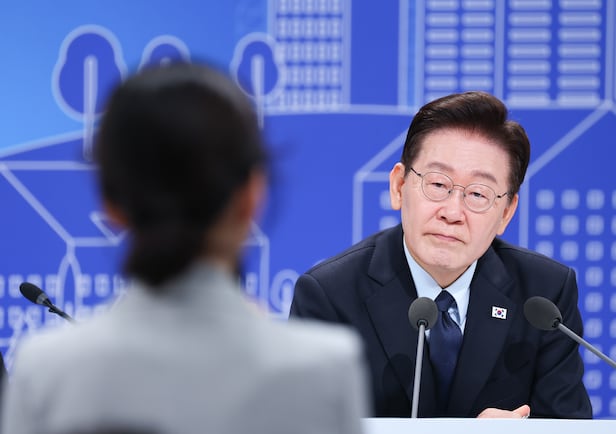
President Lee, known for his bold assertions, has a challenging task ahead, particularly with the upcoming 2025 presidential election. During his candidacy, he had set an ambitious target for the benchmark Kospi index. Reports indicate he aimed for it to reach 5,000 during his term, an assertion made while the index hovered around 2,500.
Remarkably, the Kospi did briefly cross the 5,000 mark in January 2026, a mere six months after he took office, largely fueled by a boom in AI-related chip production. However, his government’s initiative to shift household wealth from real estate to more robust financial markets has yielded mixed results.
As of today, the benchmark index sits at approximately 6,700, having experienced notable fluctuations driven largely by significant players such as Samsung Electronics and SK Hynix.
Experts have weighed in on the potential risks associated with comparisons to Japan’s past. Kang Min Joo, a senior economist specializing in South Korea and Japan, stated, “I believe the likelihood of a significant real asset bubble burst in Korea is relatively low.” She pointed to stringent mortgage lending conditions and robust regulatory controls on loan-to-value and debt-to-income ratios as mitigating factors.
While the household debt-to-GDP ratio in South Korea stands at 90.14 as of 2024—down from a peak of 98.67 in 2021—it remains the second-highest in Asia, trailing only Australia.
Kang noted that the risks to financial stability appear to be contained, particularly since buyers are mandated to make substantial down payments. This reduces the likelihood of negative equity that could jeopardize banks. Other economists have echoed her sentiments, asserting that unlike Japan before its crisis, South Korea hasn’t experienced massive capital inflows or significant currency appreciation, factors that could further complicate its economic landscape.
The Bank of Korea has exhibited a proactive approach to managing inflation and financial instability, responding more decisively than Japan did during its pre-bubble years.
With an undercurrent of concern regarding rising housing prices, President Lee’s invocation of Japan’s example reflects the precarious balance South Korea seeks to maintain in navigating its real estate dynamics.