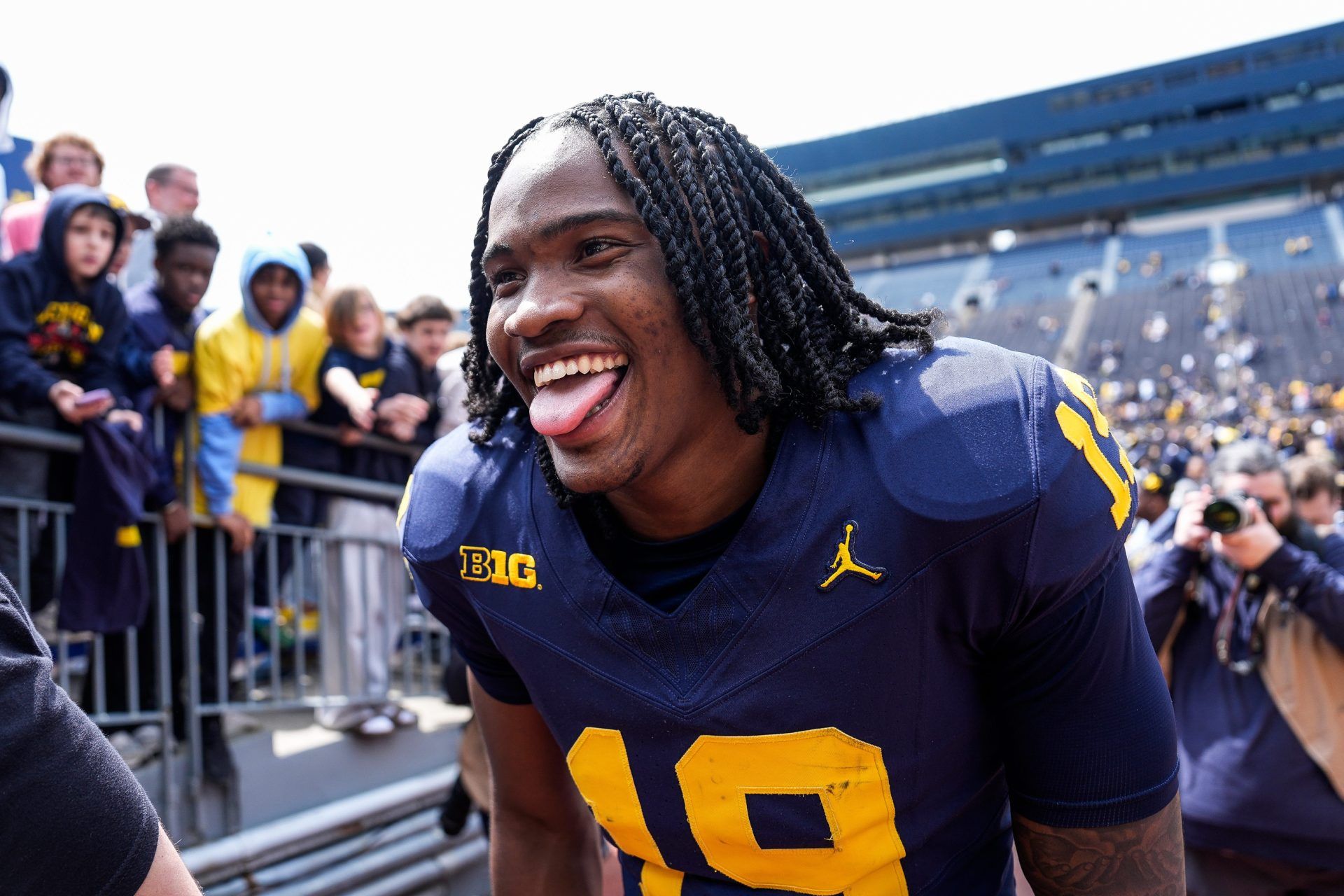
Bryce Underwood prepares for his second season at Michigan under Jason Beck, aiming for a strong performance with a revamped offensive strategy.
Bryce Underwood is looking to have a strong second season under new offensive coordinator Jason Beck, who has a history of working with mobile QBs. Dustin Markland / Getty Images
ANN ARBOR, Mich. — A quarterback named Bryce arrived on Jason Beck’s doorstep needing a coach who could harness his dual-threat talents.
The last time this happened, Bryce Perkins broke Virginia’s single-season passing record and racked up nearly 8,000 yards of total offense in two years as a starter. Perkins, who plays for the Winnipeg Blue Bombers of the CFL, said he believes Michigan’s new offensive coordinator can do the same for Bryce Underwood.
“He’s going to draw that talent out of him,” Perkins said. “Anything that’s left in there, he’s going to draw it out, for sure.”
Beck has had success with quarterbacks who could punish defenses with their arms and their legs, from Taysom Hill at BYU to Perkins at Virginia and Devon Dampier at New Mexico and Utah. Underwood has some of the same athletic traits, plus arm talent that made him the No. 1 prospect in the Class of 2025.
“I think he’s a much better thrower of the football than I first was in college,” said Perkins, who led Virginia to the ACC championship game in 2019. “I think coach Beck is going to love the type of player he is.”
Beck, 46, is in his fourth season as play caller after a decade coaching quarterbacks under Bronco Mendenhall at BYU and Virginia. Coach Kyle Whittingham hired Beck to revamp Utah’s offense a year ago, and Beck has the same task for Michigan’s offense, which had grown stale by the end of Sherrone Moore’s tenure.
The past two times Beck walked into a new job, his teams made a significant jump in total offense: from No. 45 in the FBS to No. 4 at New Mexico and No. 115 to No. 4 at Utah. Michigan, which finished No. 59 last season, hopes for a similar turnaround. The Wolverines have playmakers in Jordan Marshall, Savion Hiter, Andrew Marsh and JJ Buchanan, but a lot hinges on Underwood’s ability to take the next step.
Here’s a deeper look at what to expect from Beck’s offense.
Beck, a backup quarterback at BYU, coached QBs at his alma mater from 2013-15, when Hill was breaking out as a multi-dimensional weapon.
Hill was the prototype “Thor-terback,” a term the BYU staff used to describe Hill’s versatility and rugged running style. Ever since then, Beck has looked for quarterbacks who can extend plays with their legs and stress defenses in multiple ways.
“I love a guy that can be a weapon with his legs in the run game,” Beck said. “He still has to do the other thing at a high level to throw the football and score points and win. But to have a threat (in the run game), I definitely prefer it.”
Hill had multiple season-ending injuries at BYU, illustrating the risks of exposing a quarterback to repeated hits. Michigan was reluctant to use Underwood as a runner last year for that very reason. Underwood will be a bigger part of the running game in Beck’s offense, but the new staff still wants him to be smart.
“The best runs for us are ones where we can run, get out of bounds or get down and pick up positive yards,” quarterbacks coach Koy Detmer Jr. said.
Or, even better, find the end zone. Beck likes to put the ball in his quarterback’s hands in the red zone, and it has paid off with a bunch of rushing touchdowns. Dampier scored 19 rushing touchdowns in 2024, third among FBS quarterbacks behind Army’s Bryson Daily and Alabama’s Jalen Milroe.
Last year at Utah, Beck split those red-zone carries between Dampier and freshman Byrd Ficklin. The two quarterbacks combined for 20 rushing touchdowns, with Ficklin scoring one out of every six times he carried the ball.
Michigan doesn’t have a backup quarterback with Ficklin’s elusiveness, though freshman Tommy Carr is a capable runner. Most of those red-zone touches are likely to go to Underwood, whose 230-pound frame makes him a load to tackle at the goal line.
Utah’s performance in the red zone was one of the most dramatic aspects of the turnaround under Beck. The Utes went from scoring touchdowns on 48.7 percent of their red zone trips in 2024, No. 123 in the FBS, to 79.6 percent in 2025, which ranked No. 1.
“He took an offense that was anemic the year before, for lack of a better term, and turned it into a powerhouse,” Whittingham said. “We were fourth in the nation in scoring, second in rushing, first in red-zone production. Category after category, he took us from almost the last spots in the nation up to the top 10.”
Michigan played about 89 percent of its snaps last season in 11 personnel (one running back, one tight end) or 12 personnel (one running back, two tight ends), according to TruMedia. Utah used those two personnel groupings on about 40 percent of its snaps. Which raises the question: What were the Utes doing the rest of the time?
The answer appears to be, “A whole lot of stuff.” On this red zone snap against Kansas State, Utah lines up with one running back, one tight end, six offensive linemen and two wide receivers, one of whom is actually a quarterback. Ficklin fakes a pop pass to Dampier, who is coming in motion across the formation, and follows the pulling tackle into the end zone.
The “rhino” position makes Beck’s offense difficult to capture with the standard categories. Referring to that player as a sixth offensive lineman, a fullback or a jumbo tight end doesn’t quite do it justice. For example, here’s Semi Taulanga — all 5 feet, 11 inches and 317 pounds of him — going in motion, catching a pass in the flat and trucking a defender.
Michigan doesn’t have a player with those dimensions. The closest is probably defensive tackle Deyvid Palepale, listed at 6-2 and 322. Assuming Palepale isn’t taking snaps on offense, the rhino could be a backup offensive lineman and a bigger-bodied tight end like Eli Owens or Jalen Hoffman.
If Beck follows the Utah blueprint, Michigan will use a lot of different bodies to create unbalanced formations. Taulanga, 325-pound Solatoa Moea’i, 307-pound Keith Olsen and 276-pound Sione Motuapuaka all saw time as jumbo tight ends for the Utes last season. Sometimes it’s as simple as adding an extra tackle to move the defensive line in short-yardage situations. Other times, Beck is looking to get a big man out in space as a lead blocker or a pass-catcher.
According to TruMedia, Utah played 443 snaps with a sixth offensive lineman on the field last season, by far the most in the FBS. No other team had more than 80. Heavy formations aren’t new at Michigan, but Beck is going to bring his own creative touch to those personnel packages.
Here’s a quote from Fox analyst Joel Klatt from Utah’s game against Texas Tech last season, describing what’s distinct about Beck’s offense.
“This offense is going to use a lot of creative sets, motions and movements in order to put more players at the run point-of-attack than other teams generally do,” Klatt said. “That means more pulling linemen, more pulling tight ends and even some quarterback run.”
Beck uses a heavy dose of pre-snap motion to create misdirection and get the defense’s eyes in the wrong place. It’s rare for Beck to run a play that doesn’t have some kind of deception built in. Last season, the Utes frequently combined jet motion with gap-scheme runs using their two NFL tackles, Caleb Lomu and Spencer Fano, as pullers.
Based on reports from preseason camp, Beck has been doing a lot of the same things with Michigan’s offense.
“Coach Beck’s offense is a dynamic offense,” said linebacker Nathaniel Staehling, who transferred from North Dakota State. “You don’t see a lot of plays like that, for sure. The gap scheme has not been that difficult for me. The Missouri Valley, it was gap-scheme central. I’ve seen a lot of crazy gap scheme, misdirection, motions. It’s going to give defenses a lot of problems.”
Some of the window-dressing will look different, but the basics of those gap-scheme runs are familiar for Michigan’s offensive linemen. The Wolverines incorporated more inside and outside zone last season under offensive coordinator Chip Lindsey, but gap-scheme runs and pulling linemen have been fixtures of their run game going back to the Jim Harbaugh years.
“(It’s felt) very familiar,” right guard Nathan Efobi said. “Even with the motions, I think we’re really used to that. It’s really our game, our blood — duo, gap scheme. We love it here.”
Michigan’s identity as a run-first offense shouldn’t change dramatically with Beck’s calling the plays. Utah’s splits were 60 percent run, 40 percent pass last season, almost identical to Michigan’s. Wayshawn Parker, Utah’s lead running back, carried the ball 149 times for 981 yards, with backup NaQuari Rogers adding 98 carries.
Marshall was Michigan’s leading rusher with 932 yards on 150 attempts last season, though the carries were tilted toward Justice Haynes when he was healthy. Beck hasn’t had two running backs as talented as Marshall and Hiter at his other stops, and that’s likely to influence how often those players have the ball in their hands.
“Long yards, speed, physical runs — we’ve got two of the best backs in the country, in my opinion,” Efobi said.
Though Beck coordinated the No. 2 rushing offense in the FBS the past two seasons, his offenses aren’t one-dimensional. He’s been part of some high-powered passing attacks, including the 2021 Virginia team that finished No. 2 in the FBS in passing yards behind quarterback Brennan Armstrong. His offenses are designed to spread the ball around to multiple playmakers rather than riding a bellcow running back or a single go-to wide receiver.
“A couple years ago at New Mexico, we were actually a little more balanced than people might remember,” wide receivers coach Micah Simon said. “We had a 1,000-yard rusher at running back and a 1,000-yard rusher at quarterback who also threw for almost 3,000. We had a couple wideouts who were pushing 900 and 800 yards each. We were super balanced that year.”
More than once, Beck took a quarterback who was far from a finished product and built an offense around him. Underwood is as eager as anyone to see if he can do it again.
“I just watched everywhere that Jason Beck coached at — Virginia, Utah — and watched how he took advantage of each game,” Underwood said. “I’m excited to see what he does this year.”