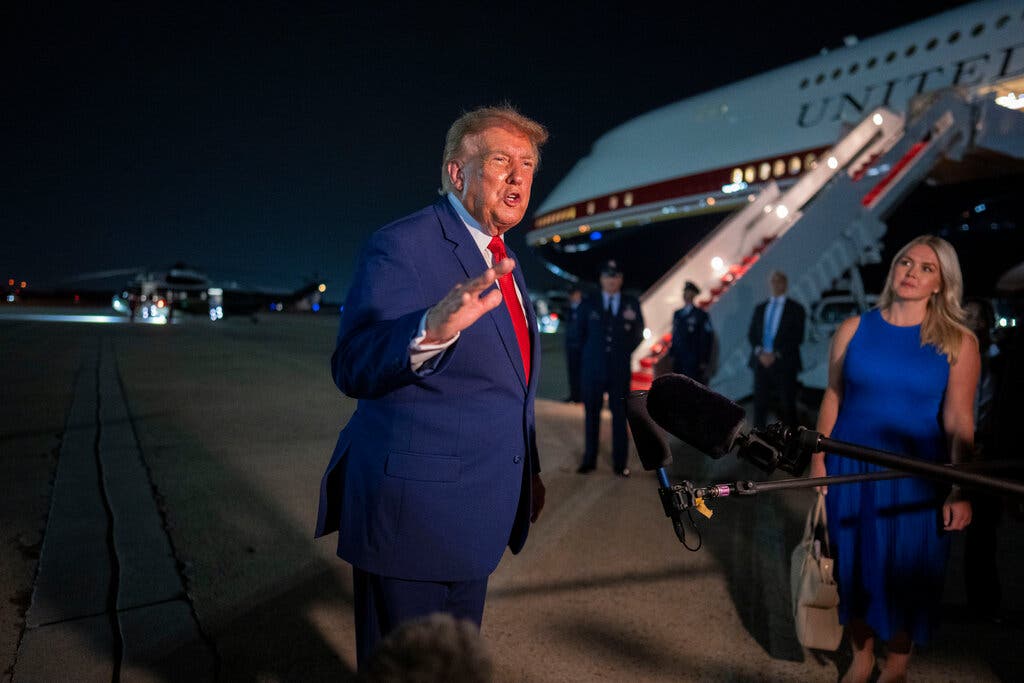
President Donald Trump has confirmed that he secretly swapped planes while leaving a NATO summit in Turkey last month due to a possible threat. “I go by Secret Service and the military. They wanted me to go in a different flight, different plane,” Trump told reporters. “I just have to do what they say.” This revelation follows reports indicating that Trump boarded Air Force One on July 8, before being moved covertly in a catering truck to a military aircraft.
The last-minute switch has sparked concerns regarding the safety of those left on the decoy plane. However, Trump noted that the jet he boarded could have been at “greater risk… because that would be the plane, I think, that they would be more likely to go for.” According to officials, U.S. intelligence detected a credible Iranian threat to fire a missile at the plane, with reports indicating that someone seen with a shoulder-fired missile was at the NATO summit.
While on Air Force One, journalists and some White House staff were unaware of Trump’s smuggling out as part of an elaborate precautionary ruse. During his time in Turkey, Trump had emphasized that he was Iran’s “number one target.” “I guess there was a threat out there,” he mentioned during a visit aboard Air Force One to an event in Ohio. “I didn’t really ask too much about it. I get a lot of threats.” He acknowledged that he faced numerous threats that are not public.

The clandestine operation came just a day after the U.S. had resumed military strikes on Iran following failed negotiations to end hostilities between Washington and Tehran. Trump had originally arrived in Turkey aboard a newer Boeing 747-8 donated by Qatar, but he eventually decided to leave on the older Air Force One “for old time’s sake.” On July 8, footage captured him boarding the presidential jet at Ankara airport, but reports revealed he slipped off onto a catering truck raised to the same height as the plane, transporting him to a smaller C-32A military aircraft, commonly used by the vice president.
Defense Secretary Pete Hegseth boarded the C-32A using external stairs to keep up the appearance of a normal flight. Meanwhile, journalists and some White House staff on the original flight were instructed to keep their window shades lowered; their unusual directive raised suspicions. A media pool producer on the plane expressed surprise when told to close their window shades. An unnamed photographer reportedly opened a shade only to be quickly told to close it again.
In a report from the White House Correspondents’ Association, it was noted that two catering trucks were present when the press arrived and that the media van was too far back in the motorcade to capture images of Trump boarding. Although “Air Force One” is the official call sign for any aircraft carrying the U.S. president, the C-32A utilized the call sign “Reach 18” during this operation, while the aircraft containing journalists continued under the designation “AF1” to facilitate the ruse.
According to The New York Times, members of Trump’s cabinet remained aboard the original aircraft. The newspaper cited anonymous officials reporting that Secretary of State Marco Rubio and Treasury Secretary Scott Bessent were among those present. On their return to the U.S. from Turkey, the American group made a stop at the RAF Mildenhall air base in the UK.
During this stop, Trump transferred from the C-32A back to the older Boeing jet, although the specifics of this maneuver also occurred in secret. He was later seen disembarking from the legacy jet as though he had always been on that flight before transferring to the new Qatari-donated plane for his journey back to Washington.
Throughout this final flight, Trump addressed reporters, acknowledging the threats posed by Iran without mentioning the prior plane swap. When asked why reporters were instructed to lower their window shades during the Turkish flight, he responded, “Because you’re probably on a dangerous flight because of the sleazebags we have to deal with.” He reiterated that he received threats regularly, emphasizing he’s considered “number one” on Iran’s “.list.”
Jose Zamora, regional director for the Americas for the Committee to Protect Journalists, stated that the Trump administration bears the responsibility to ensure journalists covering the president are not unnecessarily exposed to danger. “Reporters should be informed of credible security threats so they can make informed decisions about their safety,” he added.