A goat herder’s gold discovery ignites a rush in Kenya, drawing thousands and raising questions about mining conditions and local infrastructure.
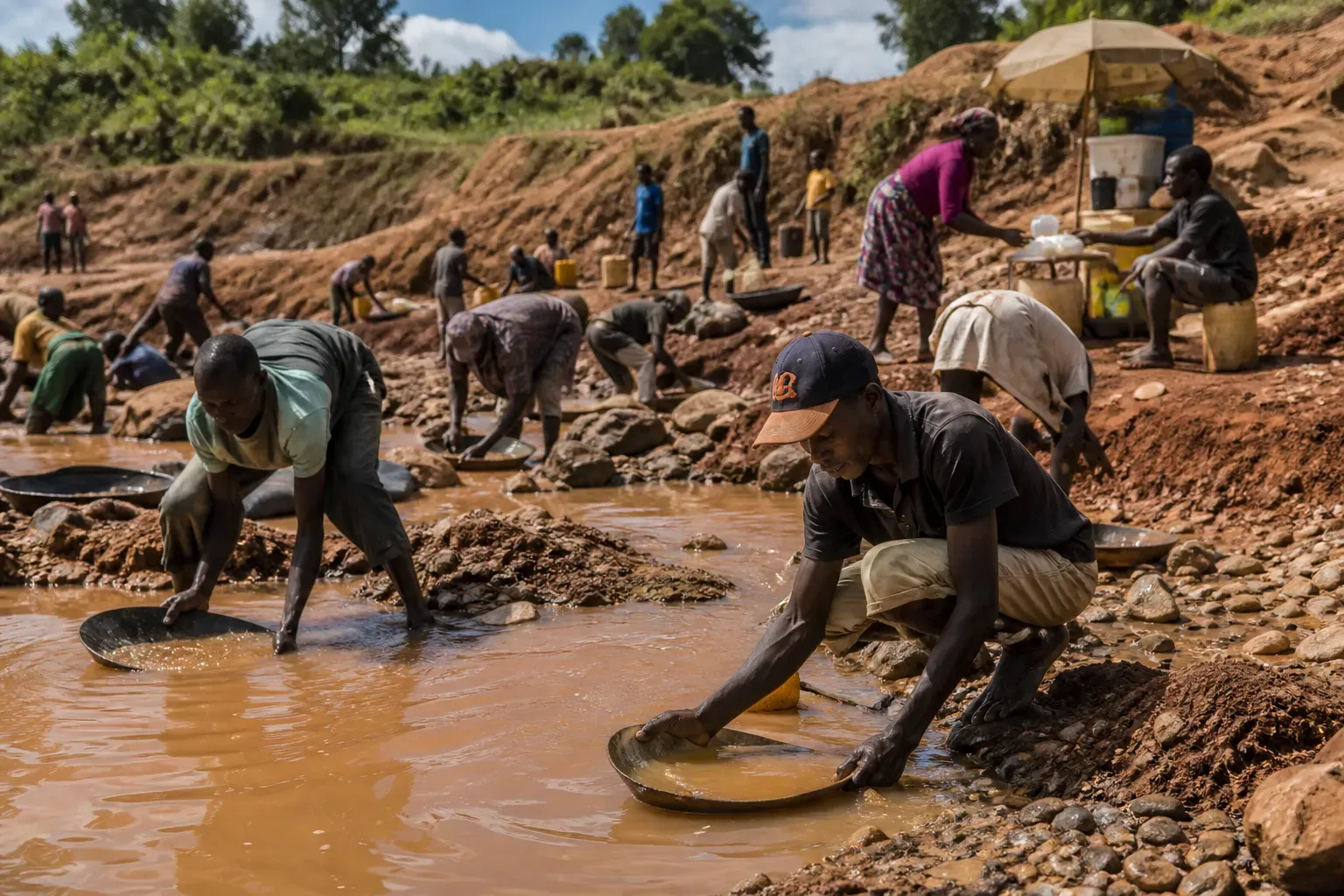
A goat herder’s gold discovery ignites a rush in Kenya, drawing thousands and raising questions about mining conditions and local infrastructure.
A goat herder from a remote area of western Kenya has said that his discovery of a golden nugget has spurred a gold rush, overwhelming his small village in recent weeks.
Thirty-three-year-old Manasse Lomachar revealed that he sold three grams of gold for 36,000 Kenyan shillings ($280; £205), an event that he believes attracted thousands of prospectors to the small village of Cheporor.
What was once merely bushland and grazing ground is now marked by pits, mounds of earth, and makeshift mining camps. Local authorities estimate that around 10,000 people flocked to the area at the peak of the rush.
The prospectors, many from Kenya and neighboring Uganda, seek a glimmer of fortune, as their livelihoods often depend on an unreliable farming income. While some locals occasionally pan for gold, significant finds are rare.
Lomachar reminisces about the moment his discovery occurred purely by chance while searching for a lost goat. Along the way, he encountered women panning in a riverbed. “I joined them, and that’s how [the village] realized there was gold in this area,” he said.
Farmer and herder Patrick Lokolia, coming from neighboring Napawoi village, joined the rush with hopes of earning extra funds for his children’s school fees. “I have children in school, and paying school fees has been a big problem for me,” he said while immersed in the mining activity.
Eighteen-year-old Abigael Chelengat, new to mining, traveled to Cheporor from a nearby district, aspiring to find enough gold for her own school expenses and to support her younger siblings.
As people work side by side, many are digging into the rocky ground with simple tools. Women can be seen in the river, sifting mud and sand in hopes of revealing precious gold traces.
Samuel Kiarie, the deputy commissioner of West Pokot county, noted that the rush reportedly began after two significant discoveries were made by local youths. “Young men found what appeared to be a substantial amount of gold. The following day, women made another significant find in the same area,” he explained.
While women have historically discovered small amounts of gold along the seasonal riverbed, it was the recent larger finds that captivated the crowds. Kiarie indicated that as rumors spread, reports of the quantity and size of discoveries were sometimes exaggerated, drawing in more people with little experience in mining.
Though the excitement has waned, the number of prospectors has declined to about 2,500 who continue their search. Despite evidence of some gold present, questions linger about the deposit’s size and its commercial potential.
“I can confirm that small-scale gold traders told us they received an average of about 100 people every day,” Kiarie stated, although the authenticity of recent finds has yet to be verified.
The discoveries allegedly vary, with potentials running from a few hundred Kenyan shillings to one find estimated at a hefty 78,000 shillings ($600).
Many individuals have traveled significant distances in search of gold, including artisans like Mugisha Godfrey from Uganda, who spent 100,000 Ugandan shillings ($27) making his way to Cheporor.
Despite harsh living conditions—sleeping under trees and working day and night—Godfrey remains undeterred. “We can’t return unless we find something. Only when we have found what we need can we go back home,” he remarked.
The gold rush has also given rise to over 200 new businesses, providing food and essentials for the influx of people. Irene Ameja, from neighboring Baringo county, capitalized on the situation, hoping that her sales of essentials will enable her to expand her business.
However, rapid growth has exposed a lack of infrastructure in the area. Ameja pointed out the evident difficulties. “This is a forest and we are in the middle of the mountains,” she said, emphasizing the absence of clean water.
Public health officials are on site to monitor conditions as local authorities express concerns over potential disease outbreaks and the safety of women and girls amid the boom.
As schools are preparing to reopen in September, there are worries about children being drawn into mining activities, prompting efforts to discourage youths from staying in the area post-rush.
For those still pursuing gold, the search is becoming more intense, with several truckloads of material having already been sent to nearby Ortum town for processing. The size and viability of economic mining in the area remain uncertain.
Lomachar believes the government should assist local miners in establishing safer extraction methods. “We would ask the government to help us with things like metal detectors, which could help us find out whether there are other minerals here, so that our community can develop,” he urged, drawing attention to the region’s ongoing poverty.
Keep in touch with our news & offers
Subscribe to Our Newsletter
Thank you for subscribing to the newsletter.
Oops. Something went wrong. Please try again later.