Mass gatherings are banned in Kinshasa as DR Congo seeks to contain an Ebola outbreak. Opposition claims the move is politically motivated.
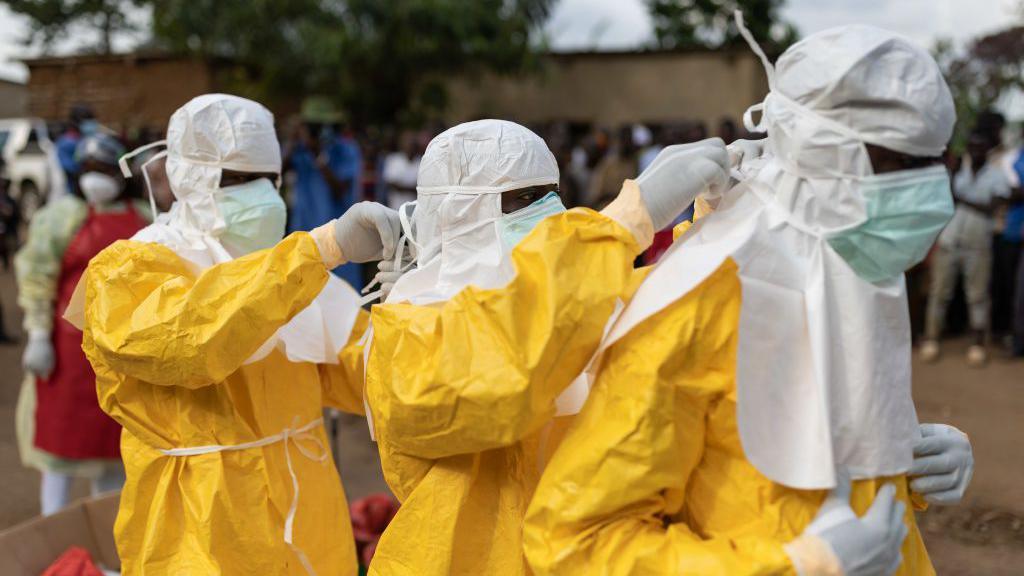
Mass gatherings are banned in Kinshasa as DR Congo seeks to contain an Ebola outbreak. Opposition claims the move is politically motivated.
Mass gatherings have been prohibited in Kinshasa, the capital of the Democratic Republic of Congo, along with three other areas, as authorities aim to curb the spread of Ebola, according to the interior minister.
The current outbreak has primarily affected three eastern provinces, approximately 1,800 kilometers (1,100 miles) away from Kinshasa, raising concerns about its potential spread to the city, which is home to 18 million residents.
The additional provinces included in the ban are Tshopo, Haut-Uele, and Bas-Uele, which border the areas where Ebola has been confirmed. Opposition politicians have criticized the government’s decision, suggesting it is a strategy to suppress a protest planned for July 8.
Prince Epenge, a spokesperson for the opposition Lamuka coalition, argued that the government is using this outbreak as a means to quash dissent. He stated, “It is not legitimate. We cannot accept this decision.”
Rodrigue Ramazani, the secretary-general of opposition party Envol, called on citizens to disregard the ban and participate in the march, accusing the government of employing the health crisis as a cover for political maneuvering.
The demonstration, organized by the C64 coalition, is in opposition to a proposed law that critics believe could allow President Felix Tshisekedi to extend his presidency beyond the two-term limit.
While no confirmed cases have been reported in Kinshasa, the region is on high alert after a doctor, who recently tested positive for Ebola in France, had traveled through the city upon returning from the outbreak’s epicenter, where he was involved in an Ebola treatment center.
In response to the situation, the Congolese government ordered a mandatory 21-day quarantine for travelers departing from Ebola-affected areas to other parts of the country.
As per the health ministry, the outbreak is presently confined to three provinces: Ituri, North Kivu, and South Kivu, with a ban on mass gatherings already in effect in these regions for weeks.
Ituri province has been hit the hardest, accounting for over 90% of the infections. Interior Minister Jacquemain Shabani issued the mass gathering directive on Saturday after confirmed cases increased by 47, bringing the total to 1,274, with known fatalities rising to 360.
Ebola cases have also emerged in Uganda, where the World Health Organization noted that 20 individuals are infected, with two deaths confirmed.
The disease is transmitted through contact with infected bodily fluids such as blood or vomit. This outbreak is attributed to the Bundibugyo strain of the virus, for which no vaccine exists.
However, the head of the Africa Centres for Disease Control and Prevention announced new antiviral drug trials could potentially commence as early as this week.
Health authorities, including the WHO, have cautioned that ongoing conflict in eastern DR Congo complicates efforts to combat the outbreak, as the M23 rebel group controls significant territories in North and South Kivu.
Keep in touch with our news & offers
Subscribe to Our Newsletter
Thank you for subscribing to the newsletter.
Oops. Something went wrong. Please try again later.