India’s Mahabaleshwar region explores local strawberry varieties to lessen reliance on imports from the US and Europe.
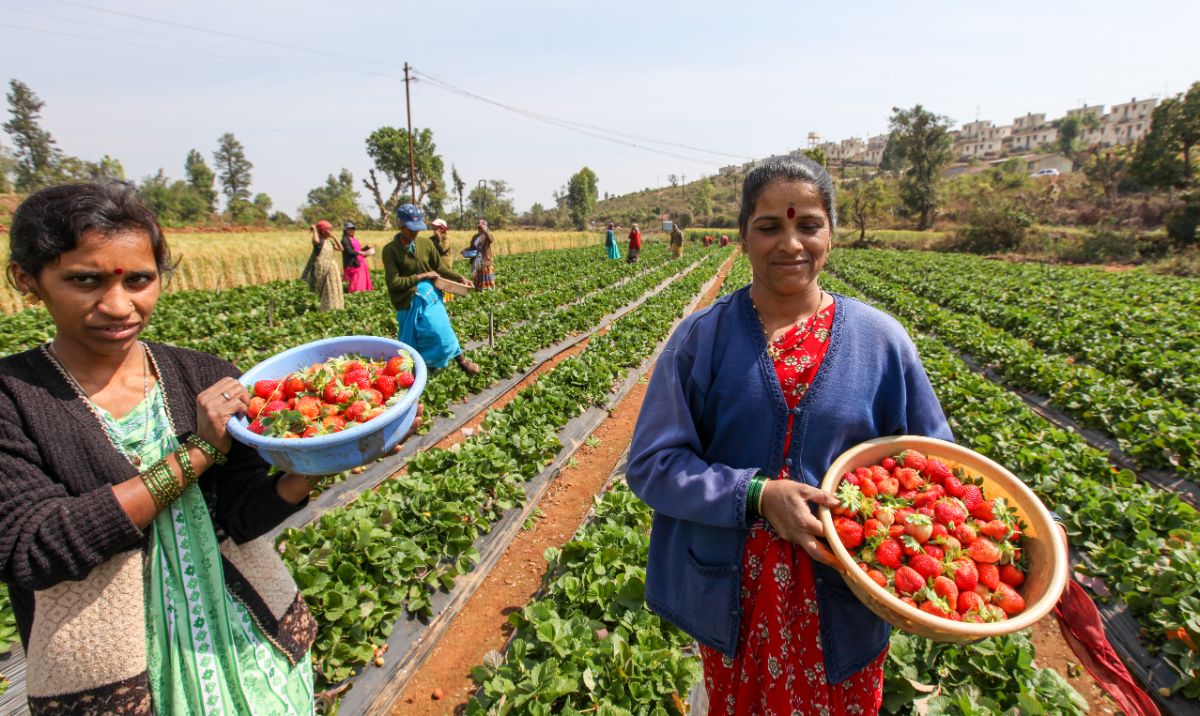
India’s Mahabaleshwar region explores local strawberry varieties to lessen reliance on imports from the US and Europe.
In the west of India, the mountainous area of Mahabaleshwar hosts the majority of the country’s strawberry farms, accounting for about 85% of India’s strawberry cultivation. The region, sitting at over 1,000 meters (3,280 feet) above sea level, benefits from a lengthy cool growing season that lasts from November to March, coupled with light, well-drained soil ideal for strawberries.
However, farming in this picturesque area comes with challenges. “If you have a field full of strawberries and sudden heavy rains hit, the entire crop is ruined and we have to bear massive losses,” says Sheetal Danavle, who tends to strawberries on half of her three-acre farm. The cultivation process is labor-intensive, requiring farmers to purchase new plants every season rather than growing them from seeds. Danavle spends around $2,500 (£1,900) each year on plant costs alone. “If the season goes well, you can earn double your investment. But the climate makes it a huge gamble,” she adds.
Despite the profitability of strawberries in western India, the industry largely relies on imported varieties originating from regions like California, Florida, Italy, and Spain. This importation process can take a decade or more, as top-quality fruit varieties are patented by breeders abroad. Nelson Sequeira, founder and director of Tara Farms Fresh, explains, “We import the certified mother plant from the breeder abroad.” Following importation, the plants undergo government quarantine before being cultivated in a nursery. A single mother plant can yield as many as 20 to 40 daughter plants, marking the beginning of a complex growing process.
While growers currently depend on imported mother plants, efforts are underway to change this dependency. Researchers at Mahatma Phule Krishi Vidyapeeth (MPKV), a progressive agricultural university in Maharashtra, are collaborating with the Bhabha Atomic Research Centre (BARC) on a breeding project. This experiment involves low-dose gamma irradiation to induce stable genetic mutations in plant tissues. Dr. Darshan Shashank Kadam, an assistant professor of Horticulture at MPKV, states, “The goal is to fast-track the development of India’s first indigenous, climate-resilient strawberry cultivar that matches the large fruit size and firm texture of foreign varieties while natively tolerating Indian heatwaves.” He notes the process could take 10 to 15 years, but in the meantime, they assist farmers by providing scientific farming practices and tailored schedules for planting and fertilization.
Investments in new technology are also being made by larger farms. Ketan Yashwant Sodha, founder and CEO of Berry Fresh Agrotech, initially met with disappointment when he transitioned from traditional open-field farming to hydroponics, a method designed to control water, nutrients, light, and temperature without soil. “I suffered immense losses and failed multiple times,” he admits. However, through experimentation with 19 varieties, including rare Japanese types, his efforts are starting to pay off. Shrinking each plant’s water intake to 750 milliliters a day creates richer flavors, and semi-open polyhouses allow for year-round cultivation.
The local traditions of strawberry farming run deep in Mahabaleshwar, as illustrated by Krishan Bhilare, whose family has been in the business for generations. He recalls the marvel of watching American varieties planted for the first time in 1992. As part of a Farmer Producer Organisation (FPO), he and his colleagues have started “smart farming” using AI technology to analyze weather patterns and advise their members on crop protection strategies. Such innovations include vertical farming methods that could increase output without requiring additional land.
However, many farmers face financial barriers to implementing such advanced techniques. Danavle, who once successfully tried hydroponic methods, faced devastation when a cyclone destroyed her entire setup. She has since returned to conventional farming but adapted her approach by leveraging social media to market her strawberries, inviting tourists to visit and pick fruit directly from her farm, thus eliminating middlemen and increasing profits.
Keep in touch with our news & offers
Subscribe to Our Newsletter
Thank you for subscribing to the newsletter.
Oops. Something went wrong. Please try again later.