South Korea’s Kospi index drops significantly as technology stocks, including Samsung and SK Hynix, fall due to investor jitters over AI spending.
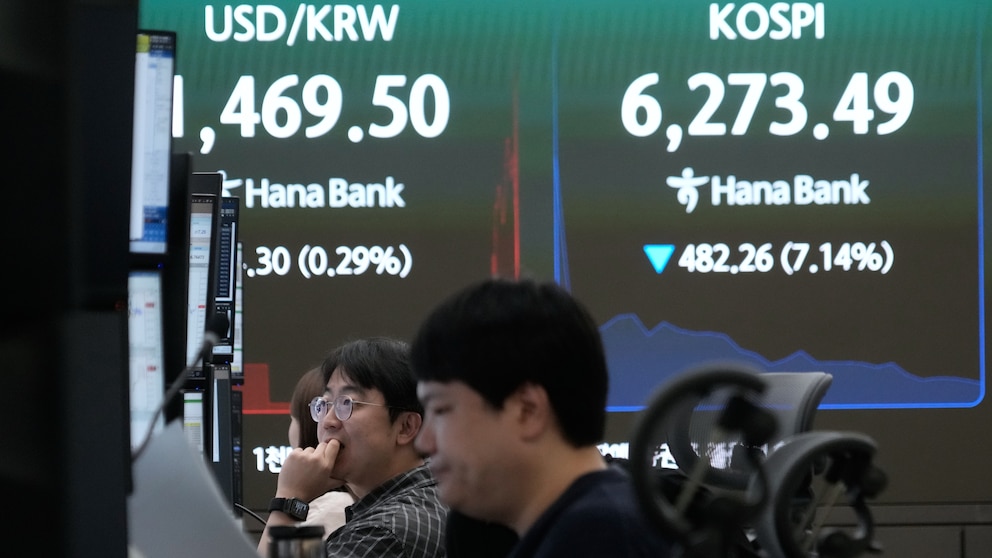
South Korea’s Kospi index drops significantly as technology stocks, including Samsung and SK Hynix, fall due to investor jitters over AI spending.
Trading on South Korea’s benchmark Kospi index came to a halt temporarily on Tuesday morning after plunging by 8%. The index continued its descent once trading resumed, closing the day down 10.8%.
The decline was driven primarily by significant losses in technology companies. Samsung Electronics and SK Hynix both experienced drops exceeding 13%, reflecting broader concerns in the tech sector.
The turmoil followed a notable decrease in AI chip giant Nvidia’s stock, which fell by 5% on Monday in New York. This loss resulted in Nvidia relinquishing its status as the world’s most valuable publicly traded company to Apple.
The tech-heavy Kospi has faced multiple halts this year due to a stock market mechanism known as a circuit breaker, which aims to stabilize trading during periods of extreme volatility. The index had more than doubled from the beginning of the year until mid-June but has since lost approximately one-third of its value.
Recent months have seen marked volatility in stock trading in South Korea, drawing in a large number of retail investors.
Japan’s Nikkei 225, which also features a concentration of tech companies, closed nearly 4% lower on Tuesday.
Investment director Jane Sydenham from Rathbones explained that the declines in the Asian market follow what she described as “phenomenal rises” in previous months. She noted that the Korean market is particularly sensitive, especially due to the heavy investment in Samsung and SK Hynix, both of which suffered substantial losses.
Furthermore, many Korean investors frequently use debt to purchase stocks, which can exacerbate price movements during market corrections.
The concerning decline allowed Apple to reclaim its title as the world’s most valuable company after seeing its stock rise by about 25% this year, even as it does not heavily invest in AI compared to its rivals.
Cheng Chye Hsern, head of investments at wealth manager Providend, mentioned that Apple remains attractive to investors wary of the significant expenditures its competitors are making to support AI development.
Sydenham stated that AI spending has been a source of anxiety for investors, questioning whether these investments will yield substantial returns in the future.
Investment firm Ten Cap’s founder, Jun Bei Liu, expressed additional concerns regarding the increasing competition from China, suggesting that investors are taking profits off the table but may reinvest in these stocks after the US holiday season.
In the meantime, European stock markets appeared indifferent to AI-related concerns, with major indices such as the UK’s FTSE 100, France’s Cac 40, and the German Dax 40 showing an uptick of around 0.6% shortly after the markets opened on Tuesday.
Keep in touch with our news & offers
Subscribe to Our Newsletter
Thank you for subscribing to the newsletter.
Oops. Something went wrong. Please try again later.