A powerful 7.1 magnitude earthquake has hit Kumamoto, Japan, trapping people in a shopping mall and causing widespread damage.
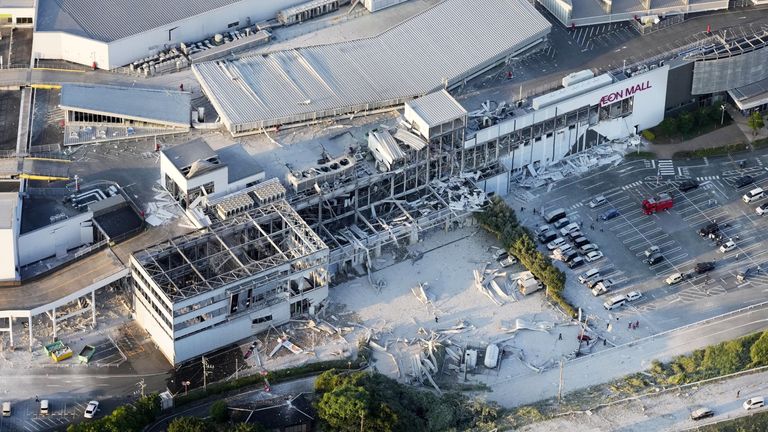
A powerful 7.1 magnitude earthquake has hit Kumamoto, Japan, trapping people in a shopping mall and causing widespread damage.
An earthquake with a preliminary magnitude of 7.1 struck Kumamoto prefecture in Japan, leading to reports of people trapped inside a shopping mall.
Emergency services confirmed that a second floor of a shopping complex in Kashima town collapsed, trapping many individuals. Authorities responded swiftly after receiving calls about what was described as an explosion at the Aeon Mall outlet, although detailed information regarding the extent of damage or casualties remains limited.
The Japan Meteorological Agency (JMA) provided insight into the seismic event, indicating that it occurred at 4:27 PM JST (7:27 AM BST) with a depth of 10 km. The tremor reached a maximum intensity of seven on the Japan Shindo scale. Initially, a tsunami alert was issued for a wave expected to reach one meter, but this warning has since been withdrawn.
In 2016, Kumamoto experienced two significant earthquakes, one measuring 6.5 and another measuring 7.3, which resulted in the deaths of 273 individuals and left over 2,800 injured.
Witness Kazuya Tsurunaga recounted feeling a substantial impact as he cleaned up dishes shattered inside a pub approximately 300 meters away from the mall. “A large cloud of smoke billowed up,” he noted, reflecting on the dramatic scenes unfolding around him.
Footage broadcasted by NHK revealed additional damage, with several buildings either on fire or partially collapsed and major cracks forming on highways. Rail services were interrupted, and flights were grounded as a precautionary measure.
Major companies in the affected area, including TSMC, Sony, and Fujifilm, evacuated their employees to ensure safety amid the ongoing crisis.
The International Atomic Energy Agency (IAEA) reported that Japan’s nuclear regulatory authority has confirmed no damage or safety concerns at the Sendai nuclear power facility after the quake.
In response to the disaster, Prime Minister Sanae Takaichi announced the formation of an “Emergency Assembly Team” to oversee the situation and implement emergency measures.
The earthquake’s epicenter was located inland, which likely mitigated tsunami risks; however, the government has urged residents to stay cautious and avoid coastal areas even after the tsunami warning was lifted.
The JMA confirmed that no tsunami activity was observed, indicating that the advisory may soon be lifted should sea level conditions remain stable. The government has activated emergency response measures in several other regions on the southern Kyushu island, including Nagasaki, Kagoshima, Fukuoka, Saga, Oita, and Miyazaki prefectures.
Japan, situated atop four significant tectonic plates along the Pacific “ring of fire,” experiences around 1,500 earthquakes annually, ranging from minor tremors to devastating quakes. Past calamities include the catastrophic 2011 disaster, which resulted in over 18,000 fatalities and a meltdown at the Fukushima nuclear plant.
The full impact of the recent earthquake is still being assessed, with authorities continuing to gather information on damage and initiate rescue efforts.
Keep in touch with our news & offers
Subscribe to Our Newsletter
Thank you for subscribing to the newsletter.
Oops. Something went wrong. Please try again later.